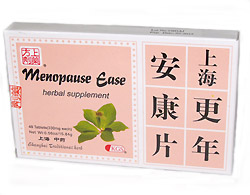

Stated by many large hospitals, this is the
best medicine for female menopause syndrome.
Kun Bao Wan is 100% pure
natural and has no any known
side effects.
The function of this remedy is resolving stagnation
for tranquilization, promoting blood circulation for removing
obstruction in collaterals. Mainly used for female menopause
syndromes such as menstruation disorder, dryness-heat
and sweating, insomnia and amnesia, easily get anger, dizziness
and ear ringing, dry throat and thirsty, sour and painful of
limbs and joints.
The product form is dark brown water-honey pills,
taste sweet, a little bitter, every 100
pills weight 10 grams, each bag contain 50 pills, 10 bags per
box.
Usage:
For treatment purposes: 1 bag a time, twice daily, after breakfast
(or lunch)
and dinner. Oral taken with warm water.
For preventing purposes: 1 bag a time, once daily, taken before
sleep.
Cautious:
1. Don’t use it when getting flu or cold.
2. Deficiency of kidney-Yang patients is not suitable to take
this medicine, the symptoms are - feel cold of body and limbs,
incontinence of feces, edema on face or limbs.
3. No Spicy or Oily food during the treatment course.
Modern Research:
1. (lab research) Researched by Beijing Tongrentang Research
Center and China TCM Research Center reported the following:
Clinical Trials:
Tested in three famous hospitals such as Beijing Tong Ren Hospital
and Beijing TCM
Hospital, tested on 330 patients of “Liver and Kidney-Yin
Deficiency” type of
menopause syndromes, the positive effective rate was on 320
patients, only 10 patients has no effects at all.
This product has been used by many TCM Doctors in Canada and
USA since early 2005.
Kun Bao Wan can significantly reduce the symptoms
of menopause syndromes, combination use of “Kun Bao Wan”
and “Jia Wei Xiao Yao Wan” can significantly calm
down the depression due to menopause. The efficiency rate is
close to 100%.
Ingredients:
Fructus Ligustri Lucidi
Fructus Rubi
Semen Cuscutae
Frultus Lycii
Polygonum multiflorum
Carapax et Plastrum Testudinis
CorexLycii Radicis
Radix Adenophorae
Radix Ophiopogonis
Semen Ziziphi Spinosae
Rhizoma Rehmanniae
Radix Paeoniae Alba
Radix Paeoniae Rubra
Radix Angelica
Caulis Spatholobi Seu Mucunae
Concha Margaritit'era Usta
Herba dendrobii
Flos Chrysanthcmi
Herba Ecliptae
Folium Mori
Radix Cynanchi
Rhizoma Anemarrhenae
Astragalus membranaeus (Fisch.) Bge
Mel. |
3.1%
2.1%
2.1 %
2.1%
2.1%
1.5%
3.1%
3.1%
2.1%
1.0%
3.1%
6.2%
3.1%
2.1%
6.2%
6.2%
3.1%
3.1%
4.1%
2.1%
3.1%
3.1%
3.1%
29.1% |